

A Breeder’s Guide by Bellatrix Cattery
By the breeding team at Bellatrix MCO & MCP LLC
Licensed European Maine Coon & Maine Coon Polydactyl Cattery | Blanchard, Oklahoma
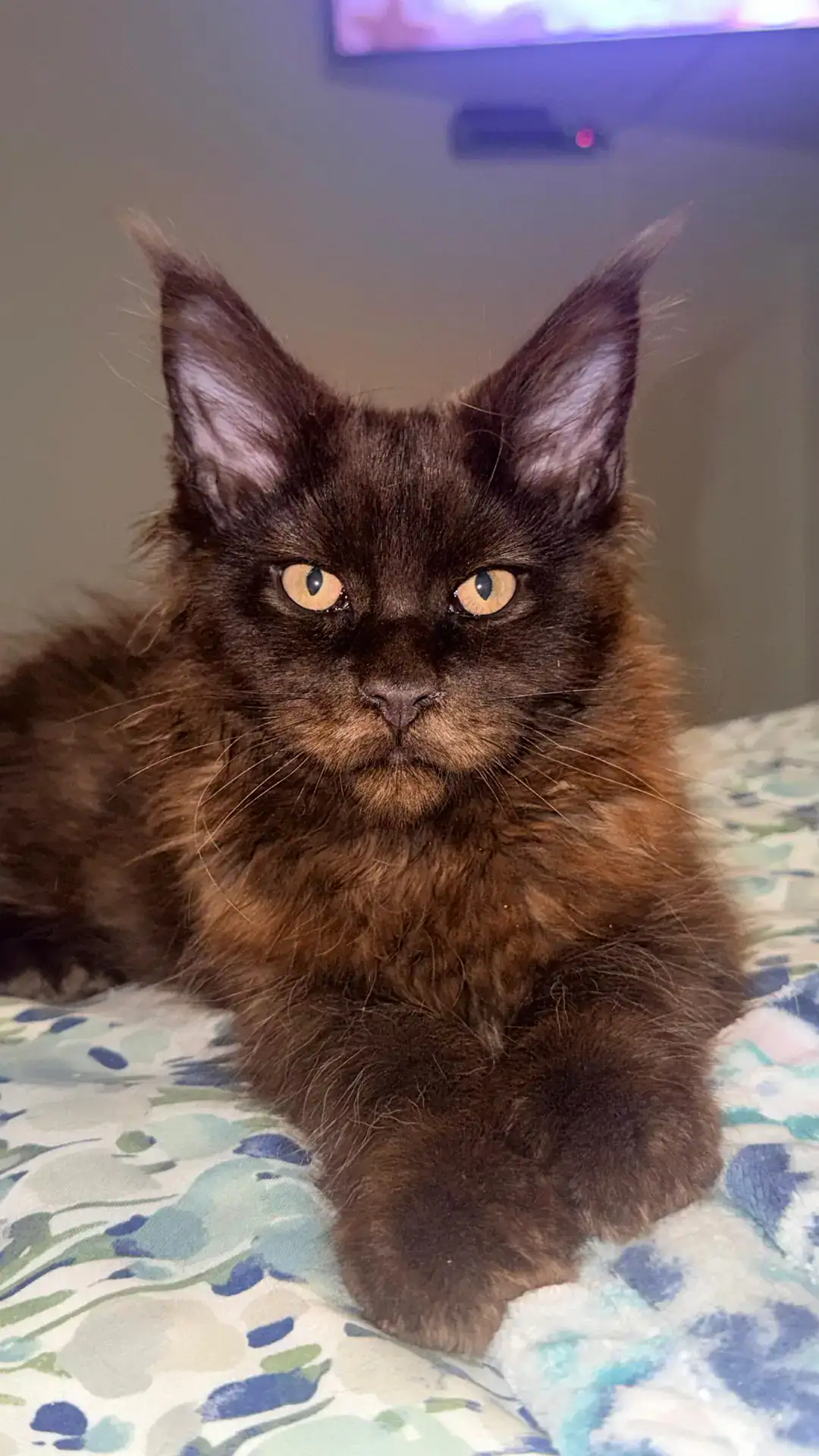
“One of the questions we are asked most frequently is, ‘Do chocolate Maine Coons really exist?’
The answer is yes—but understanding why requires looking beyond coat color alone and into feline genetics.
At Bellatrix Cattery, our breeding program is built upon health, temperament, European breed type, and responsible preservation of rare genetics. Chocolate is one of the rarest coat colors encountered within the Maine Coon breed, and because it is uncommon, it is often misunderstood.
In this guide, we explain the genetics behind chocolate Maine Coons using established feline genetic principles together with practical experience gained through our own breeding program.”
Why Is Chocolate So Rare?
Unlike black, blue, or red, chocolate is produced by a recessive variation of the TYRP1 gene.
Because the gene is recessive, both parents must contribute the chocolate allele before a kitten can display chocolate coloration.
This immediately makes chocolate kittens much less common than many other colors.
For breeders, this means chocolate cannot simply be “created.” It requires careful long-term planning while maintaining health, structure, and genetic diversity.
More Than Just Color
One of the biggest misconceptions is that breeding for chocolate simply means breeding two cats that carry the gene.
Responsible breeding is considerably more complex.
Every pairing should also consider:
- Health testing
- Pedigree diversity
- Temperament
- European breed type
- Structural correctness
- Long-term preservation of the Maine Coon breed
Color should never come at the expense of the overall quality of the cat.
A Real-World Example from Bellatrix
The kittens shown below are offspring from one of our breeding pairs and illustrate how inherited genetics can produce remarkable diversity within a single litter.
Although siblings share the same parents, each kitten receives a unique combination of genetic information, resulting in differences in coat color, pattern, expression, and overall appearance.
Rather than focusing on a single trait, our breeding philosophy evaluates the complete cat—from health and temperament to structure and phenotype.